
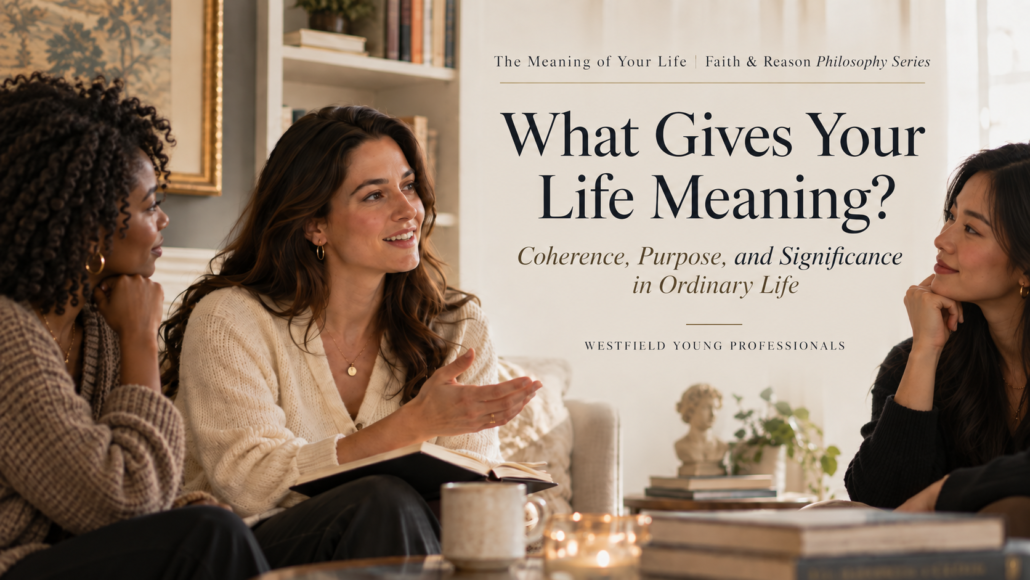
What Gives Your Life Meaning? Coherence, Purpose, and Significance in Ordinary Life
This article is a companion to Session 1 of Westfield Young Professionals’ eight-part philosophy series, The Meaning of Your Life, taught by Izzy Legaspi. Our opening session asked a deceptively simple question: What does it mean for a life to be coherent, purposeful, and significant?
There are seasons when the question of meaning arrives dramatically. A relationship ends. Your job changes. A plan you were certain would work suddenly does not. Sometimes we lose someone we love, confront an illness, or discover that the goal we spent years chasing does not feel quite the way we imagined once we finally reach it.
More often, though, the question arrives quietly.
It may appear on an ordinary Tuesday between meetings. During the commute home, it can surface while your mind finally has room to wander. Even after a perfectly successful day, something in us can still ask: Is this it?
That question does not necessarily mean something has gone wrong. Sometimes it means something deeply human is going right. Instead of asking only how to fill our lives, we are beginning to ask what our lives are actually for.
That was the starting point of our first conversation in The Meaning of Your Life. Drawing from themes in the work of social scientist Arthur Brooks and considering them through a Christian understanding of the human person, we began with three dimensions of meaning: coherence, purpose, and significance.
These three ideas give us a useful way to examine the life we are already living. As Christians, however, they also invite us to go one step deeper. It is not enough to ask whether our lives feel meaningful. We can ask what makes meaning true, what gives it permanence, and ultimately who we are in the eyes of God.
Meaning Is More Than Happiness
We often use words like happiness, fulfillment, success, satisfaction, and meaning as though they were interchangeable. They are not.
Pleasure can exist without meaning. A professional goal can be achieved and still leave us strangely empty. Hardship, by contrast, can coexist with the clear conviction that our lives are deeply meaningful.
Meaning is less about whether every moment feels good and more about whether the pieces of our lives hold together around something worth living for.
Arthur Brooks describes meaning in terms of three related qualities: coherence, purpose, and significance. Coherence asks whether the events of our lives fit into a story we can understand. Purpose asks where our lives are going and what we are living toward. Significance asks whether our lives matter, especially in relation to the people we love and who love us.
Those questions sound philosophical because they are. Yet they are also intensely practical. They shape the way we work, date, choose friends, use our time, make sacrifices, interpret suffering, practice our faith, and decide what deserves our attention.
1. Coherence: Does My Life Make Sense?
Coherence is our ability to understand our life as more than a collection of disconnected events.
Think about your own story for a moment. Some chapters were chosen; others were not. Certain decisions make us proud, while other experiences are ones we wish had unfolded differently. Friendships change us, disappointments redirect us, and some moments only begin to make sense years later.
A coherent life does not require a perfectly tidy story. Life rarely gives us one. Instead, coherence means gradually learning to see relationships among the chapters.
Ask yourself: What has this experience taught me? Which parts of myself did I discover through it? Where has good emerged that I could not see at the time? How has God used circumstances I never would have chosen?
Providence and the Story We Cannot Yet See
For a Christian, the question of coherence naturally opens onto Providence. We do not believe that every painful thing is good simply because it happened. Nor do we need to pretend that tragedy, betrayal, failure, or suffering are pleasant. Christianity makes no such demand.
What the Christian vision gives us is a larger horizon. Our story is not closed inside the limits of what we can presently explain.
Saint Josemaría Escrivá lived with a profound confidence that God can be encountered inside the real circumstances of ordinary life. Rather than telling people to wait until life became simpler, more impressive, or more obviously spiritual, he taught them to look for God precisely where they already were.
“There is something holy, something divine, hidden in the most ordinary situations.”
That insight gives Christian coherence a distinctive character. The pieces of our lives are not meaningful only because we can eventually produce a satisfying explanation for them. They belong within a relationship with a God who knows the whole story even when we can see only one page.
Coherence, then, is not control. It is not the possession of every answer. Sometimes it is simply the humble confidence that our lives can still form a whole even while part of the pattern remains hidden.
2. Purpose: Where Is My Life Going?
If coherence asks, How does my life fit together?, purpose asks, What is my life moving toward?
This can be a particularly sharp question for young professionals because we are surrounded by goals.
Finish the degree. Get the position. Build the network. Improve the salary. Find the relationship. Buy the home. Grow the business. Hit the milestone. Plan the next milestone.
None of those things is inherently wrong. Ambition can be generous, and excellence matters. Developing our gifts matters too, as does good work done with care.
Goals and purpose, however, are not identical.
A goal tells us what we want to accomplish. Purpose tells us why accomplishing it is worth doing.
Without that deeper “why,” our lives can become extraordinarily efficient and strangely directionless. We learn to move faster without ever asking whether we are moving toward the right thing.
Achievement Is Not a Vocation
This is one reason achievement alone cannot support the entire weight of an identity. Every professional success is temporary. Titles change, industries shift, and careers take unexpected turns. Eventually, someone else breaks the record, earns the promotion, or receives the recognition.
If the purpose of my life is simply to win, what happens when I do not?
An even more uncomfortable question may be this: what happens when I do win and discover that winning was never enough?
Saint Josemaría’s teaching about work helps correct both extremes. He did not dismiss professional ambition or ask Christians to become mediocre. Quite the opposite. He taught that work should be done well, with competence, responsibility, service, and love. Professional work, however, is not an idol. It becomes meaningful when it is placed within a larger vocation to love God and serve other people.
His often repeated formulation captures this beautifully: sanctify your work, sanctify yourself in your work, and sanctify others through your work.
The desk, classroom, hospital, studio, courtroom, business, home, lab, or office can become part of our path to holiness. Work does not have to become less human in order to become spiritual. Offered in love, it becomes more fully human.
3. Significance: Does My Life Matter?
The third dimension is significance.
All of us want to know that our lives matter. The trouble is that modern culture often teaches us to measure significance with instruments poorly suited to the job.
Followers. Recognition. Visibility. Prestige. Influence. Income. Applause.
Those things can measure reach, but they cannot necessarily measure significance.
A person can be known by millions and remain deeply lonely. Someone else can be known intimately by a small circle of people and leave behind a legacy of extraordinary love.
Significance becomes clearer when we stop asking, How important am I? and begin asking, To whom am I a gift?
That shift changes everything.
Our attention turns toward friendship, family, service, responsibility, hospitality, generosity, fidelity, and love. These things are not glamorous enough for an algorithm, but they are precisely where a human life becomes irreplaceable.
Christianity takes the question further still. Our significance does not begin with what we accomplish for God. It begins with what God has already done for us.
We matter because we are created deliberately, loved personally, and called into communion with Him. Human dignity is not a performance review, and we do not earn it by becoming impressive enough.
This protects us from two opposite errors: believing we are significant only when others applaud us, and believing we are insignificant when our contribution looks ordinary.
An ordinary life may be far more consequential than it appears.
The Trap of Waiting for the “Real” Life to Begin
Many of us carry a subtle idea that meaning lives somewhere else.
The right job will make my work matter. When I meet the right person, my life will finally feel complete. After I move, heal, earn more, become more disciplined, solve this problem, or reach that milestone, then I will begin living the life I am supposed to live.
Saint Josemaría’s spirituality cuts directly across that instinct.
God is not only waiting for us at the finish line. He is present in the ordinary material of today.
This does not mean that we should never change jobs, make plans, pursue growth, leave unhealthy situations, or desire something better. It means we should be careful not to treat the present as disposable.
The conversation with the coworker in front of you matters. So does the difficult task sitting on your desk. A friend who needs you, a family member who tests your patience, a hidden sacrifice, prayer squeezed into an imperfect day, and work no one congratulates you for can all matter enormously.
This is one of the most liberating elements of Saint Josemaría’s message. Holiness is not reserved for an imagined future version of our lives. Ordinary life itself can become the meeting place between human freedom and divine grace.
Meaning Is Discovered Through Love and Self-Gift
There is another thread connecting coherence, purpose, and significance: love.
Love helps our lives cohere because it teaches us which things belong at the center and which things belong at the edges. Purpose becomes clearer when love moves us beyond self-protection and self-optimization toward a good larger than ourselves. Significance, meanwhile, takes flesh when a life is given away in service rather than measured only by achievement.
This is why meaning is not ultimately a private project of self-invention.
We certainly make choices, develop gifts, discern, and build. But we discover ourselves most fully in relationship: with God and with other people.
The Christian life is not an endless attempt to stare inward until we finally solve ourselves. It calls us outward.
That outward movement includes loving God and neighbor, working well, serving, becoming capable of friendship, accepting responsibility, forgiving, and giving ourselves away without losing the truth of who we are.
Saint Josemaría summarized this spirit with an extraordinarily practical phrase: In order to be useful, serve.
Service does not make us insignificant. It is one of the ways significance becomes real.
What About the Parts of Life That Still Do Not Make Sense?
No serious conversation about meaning can ignore suffering.
Certain experiences refuse quick explanations. Loss can remain painful long after the first shock has passed. Prayers may be answered differently than we hoped, and some periods of life remain confusing for far longer than we would choose.
It is tempting to force coherence too quickly, to rush toward a lesson before we have even had time to grieve.
We do not need to do that.
A Christian understanding of meaning is not a demand that we turn every wound into an inspirational slogan.
Sometimes faith looks less like understanding and more like remaining.
We remain with Christ, stay faithful to the next duty, keep ourselves available to the people we love, and stay open to the possibility that God is working in a story whose meaning has not yet fully appeared.
Meaning can deepen even before explanations arrive.
A Practical Exercise: What Is Your Meaning Profile?
Take the Meaning in Life Questionnaire
Before you keep reading, take about three minutes to look honestly at your own relationship with meaning.
Arthur Brooks’ Meaning in Life Questionnaire is a 10-question assessment based on the Meaning in Life Questionnaire developed by psychologist Michael Steger and colleagues. It looks at two distinct dimensions:
- Presence of meaning: How much meaning do I currently experience in my life?
- Search for meaning: How actively am I looking for greater meaning right now?
The assessment does not tell you what your life means. Instead, it gives you a snapshot of where you may be standing in relation to the question.
Understanding the Four Meaning Profiles
The assessment places the two dimensions together and identifies four general profiles. Think of these not as permanent labels, but as useful descriptions of where you may be right now.
Relentless Seeker
A Relentless Seeker experiences meaningfulness in life while continuing to search for more. There can be energy and depth here, along with the temptation never to rest inside the good that has already been given.
Happy Homebody
This profile reflects a strong sense of meaning without an active search for more. That can signal genuine rootedness and gratitude, though it is still worth asking whether stability has become complacency in any area of life.
Hopeful Wanderer
Here, the search is active even though the pieces have not yet fully come together. That can be uncomfortable, but the search itself may reveal a deep openness to truth and a refusal to settle for superficial answers.
Lost in Place
Someone in this profile may not currently experience much meaning and may also feel little energy for searching. Discouragement or numbness can accompany that state. Even so, a very small movement outward – toward prayer, friendship, responsibility, service, beauty, or honest conversation – can become especially important.
No profile tells the whole story of a person. It certainly does not define your spiritual life or your worth. Use it as a starting point for attention.
Questions for Personal Reflection
After taking the questionnaire, spend a little time with these questions. Write your answers if you can. Meaning becomes easier to notice when we stop treating the question as theoretical.
- Coherence: When I look at the last five years of my life, what patterns do I notice? What experiences have shaped the person I am becoming?
- Purpose: What am I currently organizing my life around? Is it actually worthy of that position?
- Significance: Who is genuinely better because I am present in her life?
- Work: Do I see my professional work only as a means of advancement, or also as an opportunity for service, excellence, and love?
- Attention: What repeatedly steals my attention from the people, responsibilities, and moments that actually matter?
- Identity: If a major achievement or role disappeared tomorrow, what would remain unchanged about who I am?
- Faith: Where might God already be waiting for me in the ordinary circumstances I keep wishing were different?
- Love: Where am I being invited to give more of myself rather than simply optimize more of myself?
Meaning Is Not Somewhere Else
Perhaps the most important thing to carry forward from our first session is this: a meaningful life is not necessarily a more dramatic life.
Meaning grows when the pieces of our lives increasingly hold together around truth, when we move toward a worthy purpose, and when we receive life as a gift that can in turn be offered to others.
For Christians, the deepest answer to the question of meaning is not finally an idea. It is a relationship.
We are created by God, called by God, loved by God, and invited to return our ordinary lives to Him freely. That includes our ambitions, intelligence, professional gifts, friendships, disappointments, responsibilities, joys, and unfinished questions.
Saint Josemaría’s great insight was that none of those ordinary realities needs to sit outside our spiritual life. They can become the very material through which we learn to love.
So perhaps the question is not only, Where do I need to go to find meaning?
Another question belongs beside it:
What if God has already placed the beginnings of meaning inside the life I am living today?
That is not an invitation to stop growing. It is an invitation to begin paying attention.
Continue the Conversation: Session 2 on October 7
Our next session of The Meaning of Your Life moves directly from the question of meaning into one of the greatest obstacles to experiencing it deeply in modern life.
Session 2: Real Life – Love, Beauty, Faith – Freedom from Simulation
Wednesday, October 7, 2026
7:30 PM – 9:00 PM
Our question for the evening:
How can I step out of the “doom loop” and live more deeply?
We will explore how love, beauty, faith, friendship, and genuine presence can draw us back into a more fully human life in a culture that constantly competes for our attention.
Westfield Residence
500 Kelton Ave.
Los Angeles, CA 90024
Satellite locations are also available in Glendale, Rancho Cucamonga, San Diego, and Orange County.
For further exploration: Read more about Arthur Brooks’ work on meaning and Saint Josemaría’s teaching on work and ordinary life as a place of encounter with God.

Leave a Reply
Want to join the discussion?Feel free to contribute!